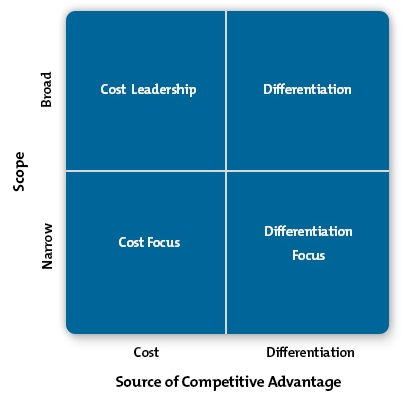
There are several
options when it comes to business strategy. Different strategists have come up
with their own versions and methods of developing strategies that best suit
businesses in different business conditions. One of the most prominent and highly
regarded such strategy is the ‘Generic Strategy’ model put forward by famous
strategist Michael Porter.
01) Generic Strategy –
Michael Porter
In this model, Porter
has put forward very basic two strategies that businesses could adopt. Although
the strategy seems simple and harmless, almost every business needs to decide
on one of the strategies put forward in this model. The two strategies are;
- Cost Leadership
- Differentiation
Cost Leadership
This is the strategy
where businesses try to be the lowest cost/price option in the market thus
attracting more customers who are more focused on cost rather than uniqueness
of a product.
A cost leader is the
business that provides products at the lowest in the market or at very
competitive low prices; hence this gives them a competitive advantage over
other businesses that have higher prices. Customers are rational, meaning they
will always try to maximize personal satisfaction and in this case personal satisfaction
means best product at the lowest price possible. So as rationale customers, the
market will prefer the low cost option most of the time (because this option
will not work with products where the price is associated with prestige and a
certain higher standard of living).
Businesses that are
into selling essential commodities can adopt this strategy better than any
other industry.
A cost leader will
always have the generic product (basic product), no improvements, nothing
additional, so as to keep the cost and thus the price to a minimum level. A
cost leader will have only a smaller margin (profit) over a product, however it
is compensated with the higher volume of products sold.
Differentiation
This is a strategy
where the business focuses on providing a unique product rather than the same
product provided by the competitors.
This will set aside the
company from the competition and provide a competitive advantage.
These businesses can
either, innovate a new product, improve the existing product or provide additional
benefits/features with an existing product, thus differentiating them from the
rest. This will require further spending and hence the price will be naturally
higher, but customers who like something new, innovative and fresh will always
go for these products rather than the same old product.
Due to the unique
nature of the product, differentiators will be able to charge a higher price
and earn higher margins, but the sales volumes will be relatively low, since
not all customers are lavish spenders.
Eg:
Apple products deliver a unique experience than any products of its nature.
Hence the price is very high, yet there is a huge demand for the products.