Showing posts with label michael porter. Show all posts

Saturday, July 12, 2014

What is Porter's Diamond Theory? (Simple explanation with examples)

Michael E. Porter has developed many theories in his lifetime and Diamond Theory or National Diamond is amongst the best of those theories. 


What is Diamond Theory?

In a nutshell The Diamond Theory determines what factors gives a firm a comparative advantage over the other firms. On a national scale it determines what factors give a country a comparative advantage on an international market. So Diamond Theory can be applied on a both micro and a macro level.


Diamond Theory diagram

As the above diagram depicts, there are four main factors influencing a firm to gain a competitive edge over the other firms. You may also notice that all the arrows connect all the four factors - meaning that all four factors affect and support each other and the firm to create comparative advantages. If not for even one factor, the model fails.


(01) Factor Conditions

One of the most crucial aspects for a country or a firm to gain a comparative advantage is the 'factor conditions'. This means that a firm or a nation should possess some unique or rare factor (or a resource) that other firms or nations do not have (or have limited) access to. Or even easier access to a resource than another firm or country could give a firm a significant advantage too. These 'factors' could mean a raw material, machinery and tools, technology, unique labor and such.

Eg: Middle East has a natural endowment of oil deposits, hence Middle East (and it's firms) possess a significant competitive advantage over the other oil producing firms and countries.


(02) Demand Conditions

This means that there should be 'sufficient' demand for a product of the firm locally. Locally means the country the firm originated in. A sufficient demand for the product locally is necessary for a firm to grow beyond the geographical boundaries of the country and gain a comparative advantage. 

Eg: Sri Lanka is world famous for Tea production. Originally this specialization began as a result of heavy local demand for tea.


(03) Related and Supporting Industries

No firm or nation is able to survive on it's won in this globalized world. And what supportive industries a firms possesses affects the development of that firm to a great extent. Supporting industries are which provides additional services to a firm. For an example transportation for a manufacturing firm is a supporting industry. Communication in general is a supportive industry for all the firms. These supporting and related industries help a firm minimize it's costs and allows a firm to focus on it's core business activities - thus giving them a competitive advantage over their core business activities.

Eg:  Amazon.com uses DHL courier services to deliver high value products across the world. DHL is a supporting service.


(04) Strategy, Structure and Rivalry

Strategy means the strategy of the firm it uses to deal with the operations of the business. A sound strategy (incorporating flexibility) is vital for an organization to deliver a world class product and gain a competitive advantage. Structure is the setting within the firm - where organizational goals, culture, strategy and line of authority is enforced. Rivalry is also a crucial factor, because it gives incentives for a competing organization to be competitive and better than its competitor, by means of product, service and productivity. All these factors affect towards the competitive edge of a country or a firm.


However, as mentioned earlier, one or two of these factors will not be sufficient for a firm or a country to gain a significant comparative advantage over another firm or a country. 


Monday, November 26, 2012

Rational Planning Model – Part III: Strategic Option Generation (Part 03)


The previous article discussed about the Diamond Theory introduced by the famous strategist Michael Porter. In this article too yet another theory put forward by him will be discussed. This strategy is known as the Five Forces Theory.


Five Forces Theory – Michael Porter

Unlike Generic Strategy and Diamond Theory, this model focuses on industry competition and developing business strategy on an industry level. This theory talks about five aspects of the industry which the business should be aware of and take into account when developing business strategy.

  1. Bargaining Power of Customers
  2. Bargaining Power of Suppliers
  3. Threat of New Entrants
  4. Threat of Substitutes
  5. Rivalry


Bargaining Power of Customers

This focuses on the bargaining power of customers within the industry as a whole. Bargaining power means the ability to influence the price of a product. Higher the bargaining power, the higher the influence of the customers will be and hence the lower the prices will get. A single customer cannot affect the market price in a general industry. However when customers get organized, unionized or when customers are backed up by government institutions, their bargaining power becomes much more intense. Hence businesses will have to be aware of the nature of the influence of the customers when setting strategy.


Bargaining Power of Suppliers

This means the bargaining power of suppliers. Bargaining power is the same concept as mentioned above and the only difference is that in this aspect, the influence of suppliers is considered. Naturally one supplier cannot influence the market price but when they are organized their power is more. They can organize and create artificial shortages of products and drive the prices up. Hence the business has to strategize to face such situations.


Threat of New Entrants

This is where the business has to focus on the new competition that generated through new businesses entering the industry. The more businesses are in one industry, the more competition will occur. A considerable level of competition is good for both the businesses and the customers. Customers will be able to enjoy competitive prices whereas businesses will be forced to be innovative and implement cost reduction practices. However very strong competition is not beneficial. Businesses will lower their prices further and further in order to attract customers and will come to a level where the business cannot cover its daily expenses. That will force the business to liquidate.


Threat of Substitutes

This is where the business has to focus on the substitute products available beyond the industry. All products can be considered to be substitutes within and industry, and that’s what makes it an industry. However this aspect focuses on the likely substitutable products outside of the industry. For an example rice could be identified as a substitute for bread, although paddy cultivation and bakery industry are entirely two different industries.


Rivalry

This merely focuses on the competition within the industry. Higher the competition the more strategic businesses will have to be, the more innovative and more differentiated.


Sunday, November 25, 2012

Rational Planning Model – Part III: Strategic Option Generation (Part 02)


The previous article discussed about the Porter’s Generic Strategy model and this article will discuss about another strategy that’s important for any business. This strategy too was implemented by Michael Porter and is named as ‘Diamond Theory’.


02) Diamond Theory – Michael Porter

This theory specifically discusses about the factors/conditions that affect a business to develop a competitive advantage over another business and come to be ‘global businesses’. Michael Porter put forward this theory in his publication ‘The Competitive Advantage of Nations’.

The theory focuses on four aspects that make the businesses globally competitive.


  1.        Demand Conditions 
  2.        Factor Conditions
  3.        Firm Structure, Strategy and Rivalry
  4.        Related and Supportive Industries


Demand Conditions

This represents the home demand for a company. In simple, the demand for the product by the country in which the business originated affects the development of the business largely. A good and strong demand from the home country will tempt and challenge the business to innovate and evolve.

Eg: The local demand for chocolates and wrist watches made Switzerland the global leader in chocolate products and wrist watch industry.
The demand for fashion within Italy made it to be the hub of world fashion.


Factor Conditions

This represents the availability and the usage of factors/resources by a business to develop a competitive advantage. According to Porter natural availability of factors is not good for the business, since then the businesses are not motivated to innovate and crate factors. These factors can include human resources, capital resources, natural resources and intellectual resources.

Eg: Availability of natural oil has given the countries in the Middle East a natural competitive advantage; however this has lead such countries to innovate less.


Firm Structure, Strategy and Rivalry

This represents how the structure (flow of decision making), strategy (the business’s course of action to achieve objectives) and rivalry (competition) help the business in gaining a competitive advantage.

Firm structure that aids fast and flexible decision making, strategy that allows achievement of objectives and rivalry which pushes the businesses beyond the limits are vital for the growth and development of a business.


Related and Supportive Industries

Diamond theory shows that a business cannot function on its own. It needs aid from a variety o other businesses, which are also known as auxiliary services. These supportive industries could be transportation, communication, warehousing, financial etc.

A strong integration between these industries will help a business to develop long term relationships, gain cost benefits and gain a competitive advantage in the long run.


Friday, November 23, 2012

Rational Planning Model – Part III: Strategic Option Generation (Part 01)


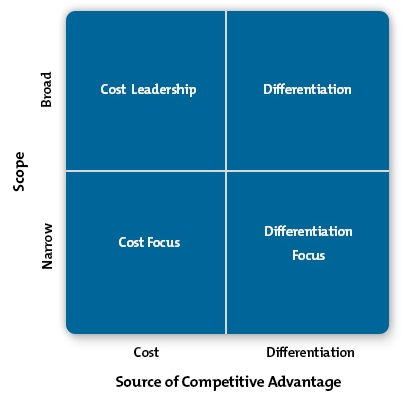
There are several options when it comes to business strategy. Different strategists have come up with their own versions and methods of developing strategies that best suit businesses in different business conditions. One of the most prominent and highly regarded such strategy is the ‘Generic Strategy’ model put forward by famous strategist Michael Porter.


01) Generic Strategy – Michael Porter

In this model, Porter has put forward very basic two strategies that businesses could adopt. Although the strategy seems simple and harmless, almost every business needs to decide on one of the strategies put forward in this model. The two strategies are;

  1. Cost Leadership
  2. Differentiation


Cost Leadership

This is the strategy where businesses try to be the lowest cost/price option in the market thus attracting more customers who are more focused on cost rather than uniqueness of a product.

A cost leader is the business that provides products at the lowest in the market or at very competitive low prices; hence this gives them a competitive advantage over other businesses that have higher prices. Customers are rational, meaning they will always try to maximize personal satisfaction and in this case personal satisfaction means best product at the lowest price possible. So as rationale customers, the market will prefer the low cost option most of the time (because this option will not work with products where the price is associated with prestige and a certain higher standard of living).

Businesses that are into selling essential commodities can adopt this strategy better than any other industry.

A cost leader will always have the generic product (basic product), no improvements, nothing additional, so as to keep the cost and thus the price to a minimum level. A cost leader will have only a smaller margin (profit) over a product, however it is compensated with the higher volume of products sold.


Differentiation

This is a strategy where the business focuses on providing a unique product rather than the same product provided by the competitors.

This will set aside the company from the competition and provide a competitive advantage.
These businesses can either, innovate a new product, improve the existing product or provide additional benefits/features with an existing product, thus differentiating them from the rest. This will require further spending and hence the price will be naturally higher, but customers who like something new, innovative and fresh will always go for these products rather than the same old product.

Due to the unique nature of the product, differentiators will be able to charge a higher price and earn higher margins, but the sales volumes will be relatively low, since not all customers are lavish spenders.

Eg: Apple products deliver a unique experience than any products of its nature. Hence the price is very high, yet there is a huge demand for the products.