Monday, November 26, 2012

Rational Planning Model – Part III: Strategic Option Generation (Part 04)


After a series of Michael Porter’s theories on strategy generations, this article focuses on Igor Ansoff’s ‘Ansoff Matrix’.


Ansoff Matrix – Igor Ansoff

This is also known as ‘Product-Market Matrix’ due to the fact that this theory focuses on the development of strategies based on products and the markets. The matrix focuses on existing products and markets and new products and markets and how strategies should be developed to face each situation appropriately.


Market Penetration

This is the strategy that should be adopted by a business when an existing product is introduced to an existing market. The market is already occupied with the same product and hence the business will have to adopt some pricing strategy to penetrate the market, preferably a cost leader approach.


Diversification

This strategy should be adopted when a business enters into a new market with a new product. A new product naturally signifies ‘differentiation’ from the existing products. However diversification is a broader concept. 

Two major aspects of diversification are horizontal diversification and vertical diversification. Horizontal Diversification signifies entering into different businesses that are related or close to the products of the current business (Eg: A soap company entering into shampoo industry). Vertical Diversification signifies a business entering into the different levels of the supply chain of the same business. (Eg: A cereal producing company purchasing a corn field – Upward Integration or the same cereal company purchasing a cereal distribution company – Downward Integration).


Product Development

This strategy deals with a business introducing a new product to the existing market. Hence strategies to develop the ‘product’ have to be initiated. Marketing, advertising, product promotions, discounts are a few strategies to be adopted.


Market Development

This is where a business introduces an existing product to a new market. So strategies to develop the market have to be adopted. Having a proper distribution channel, having convenient outlets to facilitate easy access for customers are some strategies that could be adopted. 


Rational Planning Model – Part III: Strategic Option Generation (Part 03)


The previous article discussed about the Diamond Theory introduced by the famous strategist Michael Porter. In this article too yet another theory put forward by him will be discussed. This strategy is known as the Five Forces Theory.


Five Forces Theory – Michael Porter

Unlike Generic Strategy and Diamond Theory, this model focuses on industry competition and developing business strategy on an industry level. This theory talks about five aspects of the industry which the business should be aware of and take into account when developing business strategy.

  1. Bargaining Power of Customers
  2. Bargaining Power of Suppliers
  3. Threat of New Entrants
  4. Threat of Substitutes
  5. Rivalry


Bargaining Power of Customers

This focuses on the bargaining power of customers within the industry as a whole. Bargaining power means the ability to influence the price of a product. Higher the bargaining power, the higher the influence of the customers will be and hence the lower the prices will get. A single customer cannot affect the market price in a general industry. However when customers get organized, unionized or when customers are backed up by government institutions, their bargaining power becomes much more intense. Hence businesses will have to be aware of the nature of the influence of the customers when setting strategy.


Bargaining Power of Suppliers

This means the bargaining power of suppliers. Bargaining power is the same concept as mentioned above and the only difference is that in this aspect, the influence of suppliers is considered. Naturally one supplier cannot influence the market price but when they are organized their power is more. They can organize and create artificial shortages of products and drive the prices up. Hence the business has to strategize to face such situations.


Threat of New Entrants

This is where the business has to focus on the new competition that generated through new businesses entering the industry. The more businesses are in one industry, the more competition will occur. A considerable level of competition is good for both the businesses and the customers. Customers will be able to enjoy competitive prices whereas businesses will be forced to be innovative and implement cost reduction practices. However very strong competition is not beneficial. Businesses will lower their prices further and further in order to attract customers and will come to a level where the business cannot cover its daily expenses. That will force the business to liquidate.


Threat of Substitutes

This is where the business has to focus on the substitute products available beyond the industry. All products can be considered to be substitutes within and industry, and that’s what makes it an industry. However this aspect focuses on the likely substitutable products outside of the industry. For an example rice could be identified as a substitute for bread, although paddy cultivation and bakery industry are entirely two different industries.


Rivalry

This merely focuses on the competition within the industry. Higher the competition the more strategic businesses will have to be, the more innovative and more differentiated.


Sunday, November 25, 2012

Rational Planning Model – Part III: Strategic Option Generation (Part 02)


The previous article discussed about the Porter’s Generic Strategy model and this article will discuss about another strategy that’s important for any business. This strategy too was implemented by Michael Porter and is named as ‘Diamond Theory’.


02) Diamond Theory – Michael Porter

This theory specifically discusses about the factors/conditions that affect a business to develop a competitive advantage over another business and come to be ‘global businesses’. Michael Porter put forward this theory in his publication ‘The Competitive Advantage of Nations’.

The theory focuses on four aspects that make the businesses globally competitive.


  1.        Demand Conditions 
  2.        Factor Conditions
  3.        Firm Structure, Strategy and Rivalry
  4.        Related and Supportive Industries


Demand Conditions

This represents the home demand for a company. In simple, the demand for the product by the country in which the business originated affects the development of the business largely. A good and strong demand from the home country will tempt and challenge the business to innovate and evolve.

Eg: The local demand for chocolates and wrist watches made Switzerland the global leader in chocolate products and wrist watch industry.
The demand for fashion within Italy made it to be the hub of world fashion.


Factor Conditions

This represents the availability and the usage of factors/resources by a business to develop a competitive advantage. According to Porter natural availability of factors is not good for the business, since then the businesses are not motivated to innovate and crate factors. These factors can include human resources, capital resources, natural resources and intellectual resources.

Eg: Availability of natural oil has given the countries in the Middle East a natural competitive advantage; however this has lead such countries to innovate less.


Firm Structure, Strategy and Rivalry

This represents how the structure (flow of decision making), strategy (the business’s course of action to achieve objectives) and rivalry (competition) help the business in gaining a competitive advantage.

Firm structure that aids fast and flexible decision making, strategy that allows achievement of objectives and rivalry which pushes the businesses beyond the limits are vital for the growth and development of a business.


Related and Supportive Industries

Diamond theory shows that a business cannot function on its own. It needs aid from a variety o other businesses, which are also known as auxiliary services. These supportive industries could be transportation, communication, warehousing, financial etc.

A strong integration between these industries will help a business to develop long term relationships, gain cost benefits and gain a competitive advantage in the long run.


Friday, November 23, 2012

Rational Planning Model – Part III: Strategic Option Generation (Part 01)


There are several options when it comes to business strategy. Different strategists have come up with their own versions and methods of developing strategies that best suit businesses in different business conditions. One of the most prominent and highly regarded such strategy is the ‘Generic Strategy’ model put forward by famous strategist Michael Porter.


01) Generic Strategy – Michael Porter

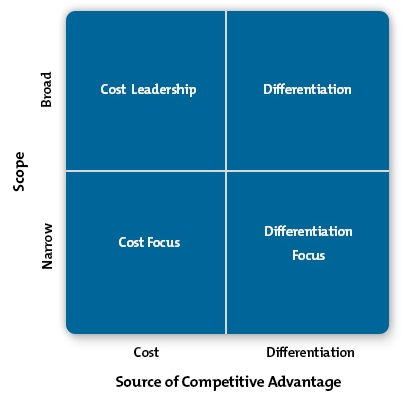
In this model, Porter has put forward very basic two strategies that businesses could adopt. Although the strategy seems simple and harmless, almost every business needs to decide on one of the strategies put forward in this model. The two strategies are;

  1. Cost Leadership
  2. Differentiation


Cost Leadership

This is the strategy where businesses try to be the lowest cost/price option in the market thus attracting more customers who are more focused on cost rather than uniqueness of a product.

A cost leader is the business that provides products at the lowest in the market or at very competitive low prices; hence this gives them a competitive advantage over other businesses that have higher prices. Customers are rational, meaning they will always try to maximize personal satisfaction and in this case personal satisfaction means best product at the lowest price possible. So as rationale customers, the market will prefer the low cost option most of the time (because this option will not work with products where the price is associated with prestige and a certain higher standard of living).

Businesses that are into selling essential commodities can adopt this strategy better than any other industry.

A cost leader will always have the generic product (basic product), no improvements, nothing additional, so as to keep the cost and thus the price to a minimum level. A cost leader will have only a smaller margin (profit) over a product, however it is compensated with the higher volume of products sold.


Differentiation

This is a strategy where the business focuses on providing a unique product rather than the same product provided by the competitors.

This will set aside the company from the competition and provide a competitive advantage.
These businesses can either, innovate a new product, improve the existing product or provide additional benefits/features with an existing product, thus differentiating them from the rest. This will require further spending and hence the price will be naturally higher, but customers who like something new, innovative and fresh will always go for these products rather than the same old product.

Due to the unique nature of the product, differentiators will be able to charge a higher price and earn higher margins, but the sales volumes will be relatively low, since not all customers are lavish spenders.

Eg: Apple products deliver a unique experience than any products of its nature. Hence the price is very high, yet there is a huge demand for the products.


Thursday, November 8, 2012

Efficient Market Hypothesis (EMH)

This is the age of information, where information is more powerful than any weapon. The markets are changing rapidly and information is the key to identifying such changes and reacting to them in the best possible way. Information gives us the business a path to follow, targets to achieve and a competitive advantage, if used correctly.

Efficient Market Hypothesis (EMH) defines three levels of information availability in a market (mainly financial markets).


  1. Strong Market
  2. Semi-Strong Market
  3. Weak Market

Strong Market

EMH says that in a strong market perfect information exists and is highly efficient in information distribution. This means that, in a market, all past information, present information, all disclosed information and all undisclosed information are publicly available. In practice, this is highly unlikely and could be concluded that such markets do not exist. If such markets exist, everybody would be making unlimited and continuous profits within markets, and that is not practical.

The prices of financial instruments trading in these markets will instantly reflect the availability of undisclosed information (insider information). 


Semi-Strong Market

EMH defines a semi-strong market as one with all past information, present information and all disclosed information. Typically this is the type of market that exists most of the time. Businesses will do anything to prevent important information leaking out to the market  since that gives their competitors an enormous advantage. So undisclosed information stays undisclosed and publicly hidden.

The prices of financial instruments trading in these markets will instantly reflect the availability of public information. 


Weak Market

EMH says that Weak Markets only give out the past disclosed information to the public. Decision making can be tough and rigid in these types of markets.

In these markets prices of financial instruments will only reflect based on the past information.


Sources : http://en.wikipedia.org/wiki/Efficient-market_hypothesis 

Friday, October 26, 2012

Benchmarking


The modern business world is highly dynamic and competitive. It is highly essential to stay on top of the game even to survive in the industry. This is where benchmarking becomes helpful to all organizations.

Benchmarking is the process of comparing our performance with the industry best performance and developing strategies to reach that level. In this process we can identify our weaknesses and limitations and the strengths of the best performer and try to develop our own strengths.
Benchmarking is threefold,

  1. Internal Benchmarking
  2.  External benchmarking
  3. Strategic Benchmarking


Internal Benchmarking

This is where certain departments or sections of an organization benchmark each other. The significance is that performance comparison is done within the organization itself. For an example the production department may have an optimum output of 5 million units, and the marketing department can benchmark this and try to sell all of the units.


External Benchmarking

This is also known as competitor benchmarking. Yes, this is where an organization compares its performance with the best in the ‘industry’, usually the market leader. This will allow the company to really realize the weaknesses of the organization as a whole.
Eg: Lexus benchmarking BMW and Benz.


Strategic Benchmarking

This is a more ‘ambitious’ approach where a company benchmarks itself with one of the best in the whole market, despite the industries. This could be quite overachieving since there maybe companies that have unlimited potential than the industry our company operates in. However this form of benchmarking will really give a boost to our company performance.


Despite these benefits benchmarking does have some disadvantages. The main one being, losing focus on the customer needs. The company maybe striving to achieve the best performance and amidst all this commotion we may forget what our customers really want. Also a ‘best practice’ may not remain for a long time. The best performer will always try to achieve more, so there will be an endless tailing behind the market leader. Also there is no way to be sure that industry best performers’ strategies will suit our organizational culture and structure and this may lead to resistance to change.

Sunday, October 21, 2012

Game Theory (Economics)


What is Game Theory? It is the study of the interactions between a few or more elements occurring in a specific environment. That is my version of the definition of course, the way I understand it. However Game Theory appears in many fields of studies, for an example more commonly in mathematics and economics.  John Forbes Nash was the Nobel Prize winning mathematician who is honoured with the formulation of the Game Theory.

In economics Game Theory refers to;

“the study of mathematical models of conflict and cooperation between intelligent rational decision-makers” – Wikipedia

Simply it is a form of strategic decision making relevant to the competition within a market.


Game Theory consists of four core areas.

  1.  Deterrence
  2. Cooperation
  3. Changing the rules of the game
  4. Repeat games


Deterrence

This means that the players within the industry/market compete so heavily that it actually results in negative outcomes for all the players and the sustainability of the industry. Basically it leads to ‘unhealthy competition’.

Features of Deterrence

  •           Reduction of prices
  •           Heavy expenditure on advertising simply to fight competition
  •           Unethical competition
  •           Liquidation of businesses unable to face heavy competition

In such instances the government or any other regulating body will have to intervene the market and implement some rules, regulations and restrictions to save the industry.


Cooperation

This is quite the opposite of Deterrence discussed above. Here the players in the market will understand the market and the existence of other players and work in cooperation. The players will understand and respect the values and long term vision of the industry and will not act to destroy it for personal gain.


Changing the rules of the game

This is where some player in the market decides to do something different or swim against the current. The player will try to change the structure and the form of the game in order to achieve a competitive advantage over the other players. It could work both ways, for his advantage or for the downfall if not implemented properly.


Repeat Games

This is simply the cycles of games being played over and over again throughout a period of time. This is quite similar to Cooperation. The players will acknowledge the presence of other players in the market and adjust themselves based on the strengths and weaknesses of each player.